
RESEARCH: Reducing the carbon 'hoofprint'
Posted 13 July 2010
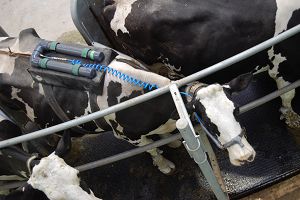
Dairy cows at Harper Adams have been wearing special backpacks to monitor their methane output, in hope of finding a way to reduce greenhouse gases.
Researchers at the Shropshire-based University College are hoping that the project will indicate which feeds and substrates produce the least amount of rumination, and in turn, fewer greenhouse gases.
Dairy cows can produce up to 500 litres (356g) of methane per day, a gas which has a global warming potential much greater than that of carbon dioxide. Professor Liam Sinclair and Dr Kenton Hart hope that the research will prove invaluable to farmers.
Prof. Sinclair said: “Dairy cows, as ruminants, produce quite a lot of methane as a consequence of their digestive system. As well as being bad for the environment, this is also ineffective for farmers because it’s wasted energy that could be used to produce milk.
“So, we’re looking at different diets to reduce the methane production and the backpacks monitor this by taking a sample of gas, from the front of the cow, for a period of 24 hours. This means that at the end of a day, we know exactly how much methane a cow has produced and how this then relates to the different feeds.”
The cows wear the backpacks for five day periods, after which they are introduced to a different feed and substrates, given time to adjust, and then the packs are worn again to monitor the next set of results.
Although the packs may look uncomfortable, the cows still behave as normal. Professor Liam added: “The cows don’t seem bothered at all because they are happy to eat, ruminate and lie down, it doesn’t seem to affect them. They soon get used to them.
“What we are trying to do is provide farmers with advice to help them reduce their carbon footprint, or carbon ‘hoofprint’, because if any carbon taxes are introduced, farmers need to know what action they can take. This will also help their animals to become more productive, so really, it’s a win-win situation.”
This is among several dairy cow research projects currently being undertaken at Harper Adams. Others include the welfare implications of grazing high-yielding dairy cows, and the effect of organic and inorganic copper on copper status and performance in dairy cattle.
Most popular
-
 Harper Adams University and Lincoln University, New Zealand, launch global agricultural futures alliance
17 September -
 Harper Adams University launches free and immediate mental health and wellness support for students
18 September -
 Watch: Students join 125 years of pioneers at 2026 Graduation ceremonies
16 September -
 Expanded clearing places designed to meet industry challenges
17 August 2022 -
 Her Royal Highness The Princess Royal to formally launch Harper Adams University's 125th anniversary celebrations
2 September -
 First Honorary Degrees and Fellowships to be bestowed as Harper Adams University marks 125th year
10 September