
Cookies on the Harper Adams University website
We use cookies to ensure that we give you the best experience on our website. If you continue without changing your settings, we'll assume that you are happy to receive all cookies on the website. However, you can change your cookie settings at any time.
It started with a fridge. Not a flashy piece of technology, just a fridge quietly sitting on campus filled with food that might otherwise have been thrown away.
It's estimated by UNEP and WRAP (2024) that in 2022, an estimated 1.05 billion tonnes of food were wasted globally at household, food service and retail levels, with households accounting for around 60 per cent of that waste.
Much of it was food that had been intended for people to eat. Some was still perfectly edible. Some had spoiled before it could be eaten. Food produced for human consumption that, for one reason or another, was never eaten.
And the problem isn’t just what ends up in the bin.
Every piece of food that is wasted represents resource used for no purpose: land and water used to grow it, energy to package, produce and deliver, and all those touchpoints using human labour along the way.
What makes food waste particularly rotten is that whilst perfectly good food is being discarded, food insecurity remains a reality for millions of people around the world, including in the UK.
We wanted to make a difference to that.
Tackling food waste doesn’t have to start at global policy, or world-changing invention. Sometimes it starts with a fridge.
A fridge on a university campus. And, in this case, quite a lot of bananas.
1.05 billion tonnes of food is wasted globally each year - 60 per cent of which comes from households.
*The Waste and Resources Action Programme, 2024
The Community Fridge was launched in January 2024 with a straightforward purpose: take surplus food and give it purpose.
The concept is simple. Students and staff can donate surplus food can donate surplus food for anyone in the community to take what they need. Food is sourced from a mixture of donations, including local supermarkets and food redistribution organisations.
It is led by Dr Iona Huang, with colleagues and students helping to develop and operate the pilot.
Iona said: “The Community Fridge not only raises awareness of food surplus and waste issues across the food supply chain but also provides valuable support to students and staff who may need a little extra help.
“This collective effort truly reflects our commitment to making sustainability inclusive and practical and part of everyday university life."
The Community Fridge was designed not only as a practical community resource, but also as a research, teaching and learning initiative. It provides a real-world setting to support the development of sustainable citizenship by helping students, as consumers and future decision-makers across the food supply chain, recognise how their choices and actions can contribute to more sustainable food systems.
But it came with a twist.
This wasn't just a fridge. It was a fridge you could watch online.
“The Community Fridge not only raises awareness of food surplus and waste issues in the food supply chain - but also provides valuable support to students and staff who may need a little extra help.”
Dr Iona Huang
The fridge you can see from anywhere
The fridge, and the food it contains at any one point, is live-streamed online using an innovative system developed by Senior Agricultural Engineer Matthew Butler and Robotics specialist Sam Wane.
It will take a picture of the fridge’s contents when the stock changes and no objects or people are in front of the fridge or freezer – meaning that pictures are not taken of people who may be using the fridge.
Looking for ingredients for dinner? Maybe fancy a snack? See what’s available from the comfort of…well…anywhere!
A bespoke app developed by the Community Fridge team records the amount of food redistributed, the number of unique users and the number of visits.
And those numbers tell the story.
At the time of this article, ~52,250kg of food has been saved since January 2024, the equivalent of 124,405 meals redistributed, 126,602 kg CO2e, 138.99 million litres of water and 14.63 ha of land use avoided as well as the associated packages (at least 2430kg) recycled.
@harperadamsuniversity When Radio 1Xtra Presenter, Swarzy Macaly heard about our #CommunityFridge Project, she was that excited she just had to come and see it for herself! 👀 So far, the project has saved more than 4.8 tonnes of food from going to waste since January this year! As part of her visit, she met Dr. Iona Huang who is leading the inter-departmental project, and she discussed on the topic of Best Before Dates and Use-By dates in recognition of #WorldFoodSafetyDay today. Understanding best before and use-by dates on #food products not only helps keep food safe, but helps to reduce #foodwaste. Find out more about the project, which utilises the power of #ArtificialIntelligence to livestream what produce we have available 24/7 🥗🍎🍞🥦🍽️ #TogetherWeWillMakeTheDifference #HarperAdamsUni #SpecialistUniversity #WorldLeading #AI #community #communityproject ♬ original sound - Harper Adams University
Powered by volunteers
Food can become surplus long before it becomes waste. Perfectly edible products may remain unsold when supply exceeds demand. If that surplus is not redistributed for human consumption or diverted to animal feed, it can ultimately become food waste.
Retailers need to maintain certain stock levels, even when local demand doesn't match, meaning perfectly good produce can end up being discarded. For Rob Boffey, who became involved with the Community Fridge from its earliest days, understanding what happens to that surplus was a key motivation for volunteering.
With a degree and background in Food and Consumer studies, he could explain how much food is lost through supply chains and retail practices, helping ensure more of that surplus could be safely reused rather than wasted.
But behind every box of rescued food is a person willing to collect it, transport it and get it into the fridge. For Rob, seeing food that could have been wasted instead benefit the community makes the effort worthwhile.
“More than 1.5 tonnes of food are now redistributed each month and the Community Fridge has been used by over 2,840 unique users, more than two thirds of whom are students.
“These figures highlighted to the team that the Community Fridge was not only supporting people within the community but is also helping to reduce food waste and the environmental resources associated with producing food that would otherwise go unused.
“Seeing these results makes the time and effort involved in collecting, transporting, and redistributing surplus food feel particularly worthwhile.”
The project also brings people together. So far, more than 20 volunteers have completed 1,950 surplus food collections and sorting activities. Their contribution is essential to the success of the Community Fridge. The fridge itself provides a shared space that helps build social connections among volunteers, users and others in the University community.
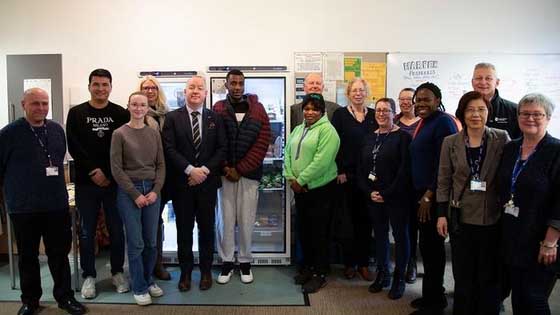
WHAT THE VOLUNTEERS SAY
“I love how it helps me connect with people across the Harper community. There was an occasion where I arrived at work in the library and a group of students had 'pulled an all nighter' and were nearly done but hungry. I was able to bring them pastries, and on this occasion sausage rolls, from the fridge so they could continue a while longer. It was an opportunity to talk about the Fridge and its aims as well as chat about their own wellbeing and studies.”
Lisa Hough, Librarian and volunteer
"It has increased my awareness of the issue of food insecurity and the scale of food waste in this country, let alone globally! An issue that is worth addressing with urgency... Seeing students take food from the fridge, knowing it helps them and while also preventing food that would otherwise be thrown away from going to waste is really rewarding.”
Dr Hairong Mu, Principal Lecturer and volunteer
“Volunteering has increased my sense of community through connection with like-minded people, and a sense of belonging to the group. There is a positive sense that we are making a difference not only to food waste but also to those who access the food. Working within Harper Food Innovation (HFI), it is nice to be able to raise awareness with the wider community of food waste/ excess within my subject area.
Jon Bentley, Senior Lecturer and volunteer
“I was taking from the community fridge often and felt it was right for me to volunteer as a way of paying back for how much help the community fridge has given me.I had no idea just how little has to be "wrong" with produce to make it unsellable. A single small tear in cardboard has left loads of canned drinks and packs of food being donated to us. Whilst I can understand the donations of food past its best-by date, I'm still in shock regarding just how much perfectly good food stores are willing to throw away.
Josie Harman, Student and volunteer
“The community fridge has really help me this year when I was struggling to buy food due to lack of money. It has helped multiple of my friends at university. I know this is wasn't the original reason for the fridge, but we are very grateful.”
Anonymous student
Inspiring student projects
At Harper Adams, bananas were becoming a familiar sight.
Bruised. Spotty. Overripe. And the more crates we took in, the more we seemed to receive. Creating a surplus.
Then a group of students recognised that the surplus bananas weren’t a waste problem, but rather a business opportunity. The question changed from “How do we save this food?” to “what can we create with it?” An overlooked problem became an opportunity for food science, enterprise and innovation.
With the support of Harper Adams staff, they explored how bananas and other surplus fruit could be frozen, freeze-dried, turned into powder and incorporated into snack products. Thus, Riff Snacks was born, and the team, comprising students from Business and Food courses, have seen their product - high-protein snack bars - go from strength to strength.
First year Food Business Management student, Lucie Campbell said: “Seeing that bananas were consistently the most wasted item, we knew we had to intervene. We wanted to turn them into something genuinely healthy—not just another banana bread!
“We set off with a simple idea: date and banana bars. But we quickly discovered that the humble banana held far more potential than we ever imagined.”
“I think people look at things and say, ‘Oh it’s bad…’ when there’s so many other things you can do…outside the box.”
@riff_snacks 10 crates of bananas 🍌 Most would make banana bread 🍞. We made banana powder. Less waste more snacks ♻️ #startup2026 #foodinnovation #students #youngenterprise #weareriffsnacks @Harper Adams University ♬ suono originale - UMC
Award winning
Riff have developed a series of bars that have seen international success, taking third place amongst 20 other teams chosen as the best in their respective countries across Europe in a Young Enterprise challenge.
Final year Food Technology and Product Development student, Hannah SURNAME, added: “It was a proud moment, and a realisation of quite how big of an achievement it was to represent our country.
“I was shocked when they announced the results. In that moment I think we all started to believe there was genuine credibility to Riff, it was no longer a temporary thing.”
For Harper Adams, it was a first: the University had never previously entered a team into the Young Enterprise programme.
For the students, it was an extraordinary leap from seeing a pile of bruised bananas to pitching their business on a national and then European stage.
“What they’ve done is exactly what sustainable entrepreneurship is all about,” says Iona. “And it embodies everything universities should promote.”
Perhaps that is what makes the Community Fridge particularly powerful. It isn't just solving a problem; it is creating opportunities to learn from the problem.
For the Riff team, the fridge became a real-world starting point for understanding food waste, consumer behaviour, product development, nutrition, sustainability and entrepreneurship.
Instead of discussing food waste purely as an abstract issue, they could see it happening in front of them.
They could identify a problem, come up with a solution and then take it into the real world.
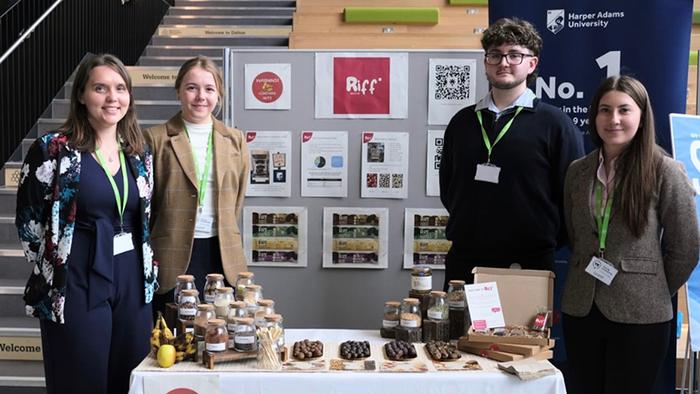
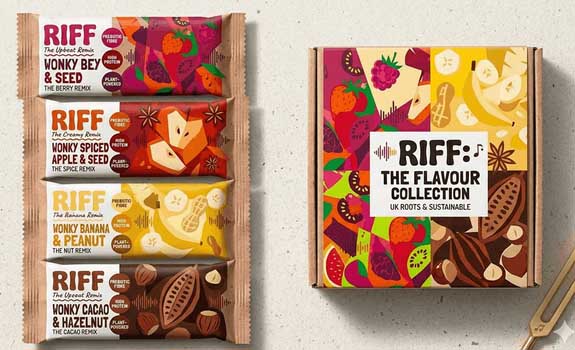
That is exactly the kind of learning that happens when education moves beyond the classroom – a principle core to all Harper Adams courses.
The Community Fridge itself was designed to support research into food waste and the use of community facilities. Its livestreaming technology was also intended to explore how data and machine learning could potentially be used to understand the fridge's contents and improve food redistribution.
At the same time, the project has become an example of what can happen when different parts of a university work together.
Academics, professional services, catering teams, students, volunteers, donors and external
organisations all play a part.
The catering team's wider work on sustainable food and reducing waste has also helped make the Community Fridge part of a broader University commitment to putting sustainable food principles into practice – not just teaching them.
That work has already attracted external recognition, with the University's food and sustainability efforts shortlisted for major sector awards.
“We are deeply honoured to receive this recognition of practicing what we teach here at Harper. It’s a testament to the creativity, dedication, and collaboration of all departments that drive us to make sustainability part of everything we do.”
Head of Catering & Retail, David Nuttall, on receiving the Green Gown Award 2025 for Campus Food and Drink.
Food waste remains a major challenge. Its scale and complexity can be overwhelming.
What started as a fridge has had a much bigger ripple effect within the institution as an educational tool, a research project, a sustainability initiative and a community builder.
Seeing food that could have been thrown away instead benefit other people provides a tangible reminder that even something as simple as a collection run can make a difference.
And perhaps that's the real strength of the Community Fridge. It turns what feels like a huge, abstract problem into something people can see, touch and actually do something about.
Because sometimes, change doesn’t start with a grand solution. Sometimes, it starts with a fridge – and a few bananas.


Harper Adams University thanks all companies and partners who are supporting our 125th anniversary programme. As a specialist institution, we especially value collaboration and engagement with organisations and companies within and related to the agri-food sector. Co-investment from sponsorship and donations is helping the University extend what we can do through our teaching, research and societal engagement.
Principal Partner

Official Launch Partner
