

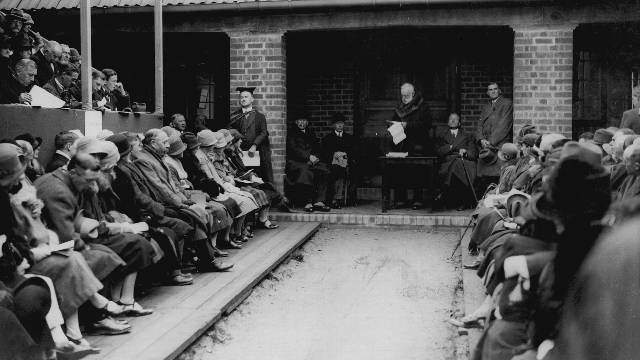
 The National Institute of Poultry Husbandry at 100 - rediscovering an eye witness account
To mark the Centenary of the opening of National Institute of Poultry Husbandry at Harper Adams, we’re sharing a contemporary acc …
Posted 3 November
The Grain Aphid: Aphids of Harper Adams with Dr Joe Roberts
4 March 2020

Over the next few days I am going to be giving a virtual tour of the various aphid cultures we maintain in the Jean Jackson Entomology Lab at @HarperAdamsUni.
— Joe Roberts (@Dr_Joe_Roberts) March 4, 2020
Follow along using #AphidsOfHarperAdams!
#AphidsOfHarperAdams
— Joe Roberts (@Dr_Joe_Roberts) March 4, 2020
Species 1 - Grain aphid (Sitobian avenae)
Grain aphid adults are ‘medium-sized’ (1.3 - 3.3 mm) and spindle-shaped that are widespread throughout the world.
This species exhibits colour polymorphism with green and brown forms being most common! pic.twitter.com/4sDDoxkS0J
These aphids are found on all cereals, including rice and maize, without host alternation.
— Joe Roberts (@Dr_Joe_Roberts) March 4, 2020
Most grass (Poaceae) species, as well as some rushes (Juncaceae) and sedges (Cyperaceae), are also suitable host plants.
Alate (winged) individuals develop in early summer leading to more colonies establishing throughout the rest of summer.
— Joe Roberts (@Dr_Joe_Roberts) March 4, 2020
Development of alate individuals is largely due to increasing population density and declining food quality. pic.twitter.com/yKJYEV3B2S
Feeding can directly result in reduced cereal yields but the biggest threat that grain aphids pose to yield is through transmission of plant diseases such as barley yellow dwarf virus (BYDV) through their saliva.
— Joe Roberts (@Dr_Joe_Roberts) March 4, 2020
BYDV infection manifests as leaf yellowing and stunting. pic.twitter.com/yaAwF4v39G
How about natural enemies?
— Joe Roberts (@Dr_Joe_Roberts) March 4, 2020
A variety of natural enemies predate on grain aphids, including:
• Ladybirds (Coccinellidae)
• Hoverfly larvae (Syrphidae)
• Lacewing larvae (Chrysopidae)
These live in the upper vegetation of cereals and predominantly feed on aphids. pic.twitter.com/smWFpCf0cV
Related Posts
The National Institute of Poultry Husbandry at 100 - rediscovering an eye witness account
To mark the Centenary of the opening of National Institute of Poultry Husbandry at Harper Adams, we’re sharing a contemporary acc …
Posted 3 November
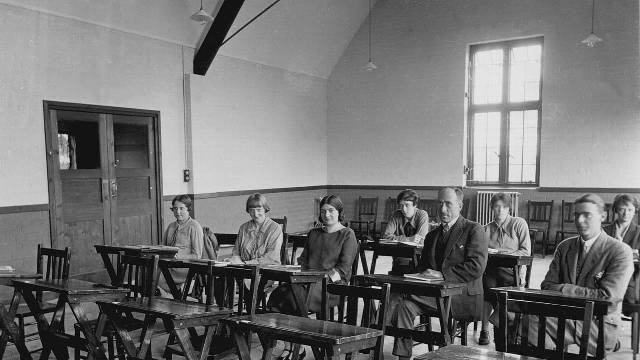 'More than 100 years of expertise' - a brief history of poultry at Harper Adams
Dr Stephen Mansbridge is Reader in Animal Science and Bioinformatics at Harper Adams University as well as Director of the Animal Science Re …
Posted 3 November
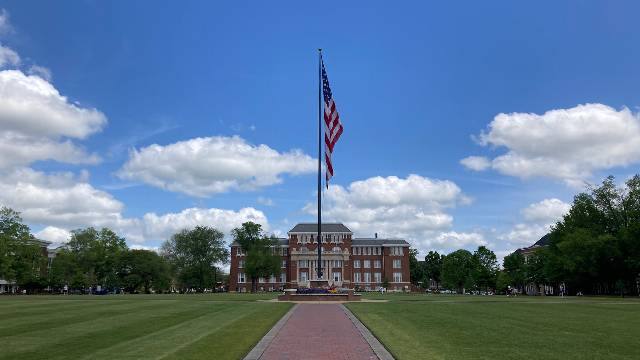 Agricultural Autonomy Institute joins Harper Adams University's 125th anniversary celebrations
A leading American expert in agricultural autonomy has paid tribute to Harper Adams University as it marks its 125th anniversary.Dr Alex Tho …
Posted 22 October
 Sky's the limit: Helen joins MP's fundraising parachute jump
A charity skydive by a Harper Adams University Business Development Consultant has helped raise more than £16,000 for a new cancer cen …
Posted 21 October