
Introducing the Ecology, Evolution and Conservation Research Group
12 June 2026
Welcome to the blog of the Ecology, Evolution and Conservation Research Group at Harper Adams University.
Our group brings together researchers across the natural sciences who share a common interest in biodiversity and the processes that shape it. Half of us specialise in invertebrates, but our expertise spans a wide range of taxa, habitats and approaches. What unites us is a shared commitment to asking big questions in ecology, evolution and conservation: from fundamental research on how biodiversity arises and is maintained, to applied work that informs conservation, welfare and environmental management.
By bringing together complementary expertise, the group aims to strengthen collaboration in biodiversity science, ecological interactions, behavioural ecology, conservation practice and responses to environmental change. Our work spans ecosystems from tropical forests to UK farmland, freshwater and marine habitats and zoological collections, and combines field ecology, molecular methods, community ecology, behavioural science and applied conservation research.
We can be found in what is currently called The Farm Seminar building (opposite the pigs). The space is being actively equipped, aiming to fully open our doors at the end of the summer.
A good place to start is by introducing the current staff members of the group. As a newly formed research group, we are still growing, and we look forward to welcoming new colleagues, students and collaborators as the year progresses.
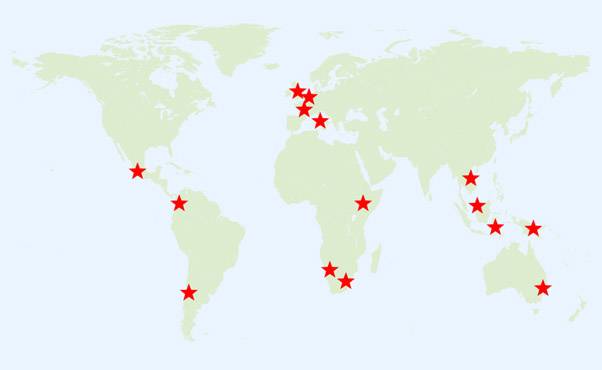
Where we work
Who we are
Dr Simon Segar
Simon leads the Ecology, Evolution and Conservation Research Group. He is a tropical entomologist whose research explores plant–insect diversity and the ecological and evolutionary interactions that generate it.
His research has taken him across the tropics, particularly to Papua New Guinea, where he has spent many years studying the remarkable relationships between figs and their pollinating wasps. Simon completed a BSc in Biology at University College London and an MSc in Ecology, Evolution and Conservation at Imperial College London, before undertaking a PhD at the University of Reading on the ecology and evolution of fig-wasp communities.
After his PhD, Simon worked as a postdoctoral researcher at the University of South Bohemia and later became Head of Laboratory at the Czech Academy of Sciences. He joined Harper Adams University in 2018 as a Lecturer in Entomology and is now an Associate Professor.
Simon’s research focuses on the processes that generate and maintain biodiversity. His current work includes the evolution of host use and chemical ecology in insect herbivores, and population genomics and speciation in figs and their pollinating wasps along tropical mountain gradients. He has also worked on arthropod phylogeny, community phylogenetics and the stability of ecological mutualisms. Much of his research combines ecology, evolution and molecular tools to understand how interactions shape biodiversity over evolutionary time.
When he is not studying fig wasps, Simon enjoys long walks with his family and dog, cycling, travelling and occasionally writing about the railway pubs of the Czech Republic.
Dr Heather Campbell
Heather is an Associate Professor in Entomology whose research focuses on insect biodiversity, conservation and community ecology. She is particularly interested in social insects, especially ants, and in the ecological interactions that structure insect communities. Her work explores how insect diversity responds to environmental change, including forest disturbance and elevational gradients, and how insect–plant interactions shape ecosystems.
Heather studied Biological Sciences at Lancaster University, followed by an MSc in Taxonomy and Biodiversity at Imperial College London and the Natural History Museum. She then completed a PhD in Ecology at the University of Reading, focusing on ant ecology and biodiversity patterns. After her PhD, she held postdoctoral positions at the University of Pretoria, South Africa, and the Hawkesbury Institute for the Environment at Western Sydney University.
Her research spans tropical and temperate systems. Much of her earlier work examined ant communities in southern Africa, including deserts, savannahs and dry forests, with a particular focus on biodiversity patterns and ant–plant mutualisms in the Kalahari. She is also involved in UK conservation research, including projects on threatened insects such as the Tormentil Mining Bee in Yorkshire.
Heather’s work also includes entomology education, public engagement, outreach and citizen science, as well as emerging research on invertebrate welfare in zoological collections. She is passionate about training future entomologists and currently chairs the Royal Entomological Society Education and Training Committee. In 2025, she received the Society’s Higher Education Award for her contributions to teaching and training.
Outside academia, Heather is a keen runner and enjoys travelling with her family. She is also gradually walking the 200-mile Shropshire Way in stages.
Dr Matt Hill
Matt is a Senior Lecturer in Conservation Science whose research focuses on biodiversity and the conservation of aquatic ecosystems. His work explores how biodiversity patterns in ponds, rivers, wetlands and other freshwater habitats change across landscapes and over time, and how these insights can inform more effective conservation and management.
Matt completed his undergraduate degree in Geography at Loughborough University, where he also undertook a PhD examining the environmental and spatial drivers of pond macroinvertebrate communities. This work quantified freshwater macroinvertebrate biodiversity, conservation value and the influence of local environmental and spatial variables on pond metacommunity structure across urban and agricultural landscapes.
Following his PhD, Matt worked as a postdoctoral researcher at the University of Worcester, where his research focused on the biodiversity of intermittent rivers and the ecological processes shaping aquatic communities. He has also held academic positions at the University of Huddersfield and Bournemouth University before joining Harper Adams University. His current research examines how community assembly processes and environmental pressures, including land-use and climate change, influence freshwater community structure and function. This includes work on ponds, canals, rivers and other freshwater habitats, as well as interdisciplinary projects exploring the social and policy contexts of freshwater conservation.
Dr Julia Casperd
Julia is a Senior Lecturer in Wildlife Conservation and Land Management and a Member of CIEEM. She is particularly interested in the behavioural ecology of vertebrates and sustainable landscape recovery. Her teaching and research draw on wildlife conservation and land management, with a focus on applying ecological science to real-world conservation challenges. Julia completed her undergraduate degree in Zoology at Dundee University and undertook a PhD on the evolution of post-conflict behaviour in Primates in the Department of Anthropology, UCL and latterly in the Department of Psychology, University of Liverpool.
Julia’s recent research has explored how lowland agricultural peat landscapes can be managed to balance conservation priorities with agriculture and as a result she is Chair of the Marches Peat Partnership and Middle Severn CaBA. A qualified River Habitat Surveyor her work is cross-cutting and connects with several research groups, including Professor Simon Jeffery’s Soil and Water Research Group. She established the Paludiculture Innovation Project with colleagues at Harper to drive research and development, teaching, and Knowledge Exchange around the mitigation of emissions from lowland peat. She is project lead for the Lowland Agricultural Peat Water Discovery Pilot Patchy Peat Solutions Project which is focused on exploring sustainable opportunities on the degraded pockets of peat prevalent in Shropshire. Julia also has expertise in Marine Biology having worked for the University Marine Biological Station, Millport and FSC Dale Fort. Her main interests relate to the cognitive strategies used by mammals and birds and how they adapt to changing environments. Locally, she supports the work of the Shropshire Mammal Group and the Shropshire BTO (including their annual expedition to Eilean Nan Ron) but is also involved in projects in Sub-Saharan Africa and the Overseas Territories.
Outside academia Julia likes to explore nature abroad and recently travelled through the Atlas Mountains in Morrocco. When not travelling, she may be found immersed in crafts, in the garden or out walking with her dogs.
Dr Jack Bamber
Jack is a Senior Lecturer in Zoology and Wildlife Management. His research focuses on applied conservation ecology, with particular interests in predator–prey dynamics, species recovery and conservation conflicts. He works mainly on native species, with research and monitoring spanning pine martens, red squirrels, capercaillie and bank voles.
Jack completed an MZool at Bangor University before working in practical conservation management with Red Squirrels Trust Wales. He then moved to the University of Aberdeen for his PhD, where he evaluated novel monitoring and management tools for conservation conflicts, particularly between pine martens and capercaillie in the Cairngorms National Park. This research combined field ecology, remote monitoring and ecological modelling to address applied conservation challenges.
Jack’s work has been closely linked to collaboration and co-production with land managers, charities, government bodies and private estates. Before joining Harper Adams, he held a lecturing role at Aberdeen, where he focused on teaching applied ecological skills to the next generation of conservation ecologists. At Harper Adams, he is continuing this work by connecting students with the realities of applied wildlife management.
His current research includes work on how the by-products of deer control influence local predator communities, alongside continued research evaluating how capercaillie productivity is affected by localised disturbance and habitat.
Outside academia, Jack can often be found out in the hills for a hike or trying to find time for a game of basketball.
Dr Ellen Williams MRSB
Ellen is an experienced ethologist specialising in exotic animal behaviour. She completed her PhD on social behaviour in elephants and has since developed a diverse research portfolio spanning human–animal interactions, animal personality, citizen science and conservation in zoological and field settings. Her work bridges animal behaviour and applied conservation, with a focus on improving outcomes for animals in managed and human-dominated landscapes.
Within zoological collections, Ellen’s research examines how managed environments influence animal behaviour and welfare. She is particularly interested in how zoos can support behaviourally robust animals, improve evidence-based management and act as platforms for public engagement and pro-conservation attitudes. Her work also explores the role of citizen science in connecting zoo visitors with conservation research.
In field contexts, Ellen investigates human–wildlife interactions, with a particular interest in human–mesocarnivore coexistence in Africa. Across these areas, her research aims to generate practical, evidence-based insights that can inform species management, welfare and conservation. She works closely with zoos, industry partners and international organisations to bridge research and practice, and is a Member of the Royal Society of Biology and the British and Irish Association of Zoos and Aquariums.
Outside academia, Ellen enjoys ambitious, and occasionally ludicrous, endurance challenges for personal wellbeing and charitable causes. She is currently aiming to swim all the lakes in the Lake District, with the largest four already completed, and will be hiking Kilimanjaro in January 2027 to raise money for Birmingham Children’s Hospital.
Dr Andy Cherrill
Andy Cherrill is an applied ecologist with long-standing expertise in insect ecology, wildlife conservation, habitat survey and environmental management. His work focuses on how species and communities respond to habitat condition, land management and environmental change, with particular emphasis on grassland, heathland and farmland systems.
A major strand of Andy’s research has examined the ecology and conservation of invertebrates, especially Orthoptera and Auchenorrhyncha. His work on rare grasshoppers and bush-crickets has helped improve understanding of their life cycles, habitat requirements and conservation management. This includes research on species such as the wart-biter bush-cricket and the lesser mottled grasshopper, both of which are of high conservation concern in Britain. More recently, his work has included baseline surveys of Auchenorrhyncha assemblages in Shropshire, contributing evidence to support habitat restoration and monitoring.
Andy’s research also extends to applied questions in land management and ecological survey. He has published on habitat classification, inter-observer variation in vegetation surveys, suction sampling methods, heath and grassland creation, and vegetation management in response to changing plant protection options. Across these areas, his work combines field ecology, practical survey skills and quantitative analysis to generate evidence that can inform conservation practice.
Alongside his research, Andy has made a major contribution to ecological and environmental education. His teaching has spanned wildlife conservation science, entomology, field survey methods, land management and statistics, supporting students in developing the practical and analytical skills needed for careers in ecology, conservation and environmental management.
Within the Ecology, Evolution and Conservation Research Group, Andy brings deep expertise in applied ecology, invertebrate conservation and field-based environmental assessment.
Together, the Ecology, Evolution and Conservation Research Group brings together expertise in entomology, freshwater ecology, wildlife conservation, animal behaviour and environmental management. Through this blog, we will share updates from our research, fieldwork, collaborations and student projects, while highlighting the ecological and evolutionary questions that inspire our work. We look forward to sharing more about the research happening within the group and the role it can play in understanding and conserving biodiversity in a rapidly changing world.


