
 Agricultural Autonomy Institute joins Harper Adams University's 125th anniversary celebrations
A leading American expert in agricultural autonomy has paid tribute to Harper Adams University as it marks its 125th anniversary.Dr Alex Tho …
Posted 22 October
Student research: can lupins support the battle against potato invaders?
18 June 2025

Guest blog from James Allanson, final year BSc (Hons) Agriculture with Crop Management.
19 years ago, bored and adventurous, I broke out of the home boundary that confined me; to “help” grade potatoes of all things! My passion and eagerness for agriculture hasn’t changed much since, eventually leading me to the challenge of an Honours Research Project (HRP).
As someone deeply excited about the future of agriculture and agricultural innovation, I was keen to undertake my HRP on the potential of lupins as a trap crop for managing potato cyst nematodes (PCN).
PCN, comprising Globodera pallida and Globodera rostochiensis, presents one of the greatest challenges to UK potato production, with infestations recorded on 48 per cent of potato fields. My project seeks to investigate if lupins can provide a sustainable solution to this pervasive issue.
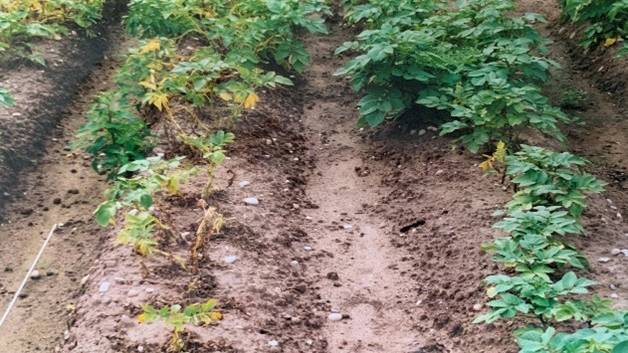
Image: potato field, showing crops damaged by PCN
Growing up on my family’s farm, I gained first-hand experience in potato propagation and the hurdles posed by pests. My academic journey at Harper Adams University, where I study BSc (Hons) Agriculture with Crop Management, equipped me with the technical skills and scientific grounding necessary to address these real-world problems. Modules such as advanced agronomy and applied crop protection have provided me with a strong foundation in pest and disease management strategies.
PCN causes extensive yield losses, and its management is becoming increasingly difficult due to restrictions on chemical controls and increasing pest occurrence.
Climate change further complicates matters, with a projected 49 per cent increase in Globodera pallida populations due to warming soil temperatures. My study focuses on identifying whether lupins could act as a sustainable trap crop to reduce nematode populations while supporting crop rotations.
The research comprises two main experiments. First, a pot trial investigates the ability of four lupin varieties to stimulate PCN egg hatching rates. Using soil naturally infested with Globodera pallida, this study evaluates population changes post-lupin cultivation.
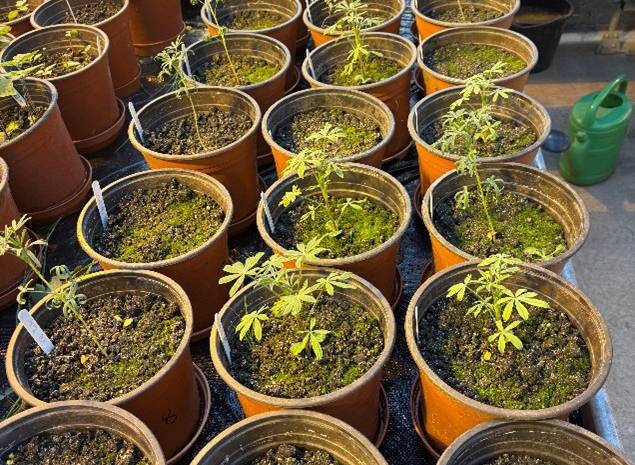
Secondly, a root diffusate bioassay compares the hatching stimulation effect of lupin root exudates against potato and distilled water controls. Both experiments employ rigorous statistical analysis to ensure the findings are robust and reproducible.
The potential practical implications of my research are vast. Trap cropping with lupins could reduce nematode populations and extend the viability of potato-growing land in the UK. Furthermore, as farmers face increasing environmental and economic pressures, incorporating sustainable practices like trap cropping could support the UK’s Net Zero ambitions while maintaining food security.
Conducting this project has strengthened my scientific and professional skills. Beyond laboratory work, it has deepened my understanding of research methods, statistical analysis, and the importance of experimental design.
This HRP is a stepping stone in my ambition to become an arable farm manager who leads with innovation and a commitment to sustainable practices. As a proud advocate for the future of British agriculture, I believe research such as this paves the way for a resilient and sustainable farming industry.
Related Posts
Agricultural Autonomy Institute joins Harper Adams University's 125th anniversary celebrations
A leading American expert in agricultural autonomy has paid tribute to Harper Adams University as it marks its 125th anniversary.Dr Alex Tho …
Posted 22 October
 Sky's the limit: Helen joins MP's fundraising parachute jump
A charity skydive by a Harper Adams University Business Development Consultant has helped raise more than £16,000 for a new cancer cen …
Posted 21 October
 From dairy farm - to farm vet
Growing up on a dairy farm played a huge part in shaping Harriet Brimacombe’s ambition to become a vet. Now, as she prepares to …
Posted 20 October
 Listen: Archers anniversary marked with future of farming discussion on BBC radio
With BBC Radio Four marking the 75th anniversary of the Archers this year, Farming Today has taken the opportunity to look forwards this wee …
Posted 16 October