

 Showcasing Harper Adams at the UKACT Annual Conference 2026
By Dr Ellen Williams "Harper Adams are very well represented this year, aren’t they?"What a fabulous thing to hear at the UKACT A …
Posted 28 August
Showcasing Harper Adams at the UKACT Annual Conference 2026
By Dr Ellen Williams "Harper Adams are very well represented this year, aren’t they?"What a fabulous thing to hear at the UKACT A …
Posted 28 August
PhD student visits the Knepp Estate in West Sussex
14 May 2026
PhD student Sophie Rabone shares her experiences of visiting the Knepp Estate in West Sussex. You may have already seen Sophie's research shared on the BBC and the Harper Adams University website. This blog, in Sophie's words, tells us about a great fieldtrip she had recently.
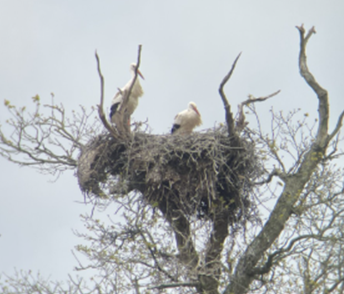
When standing on the edge of the restored wetland constructed by recently reintroduced beaver, surrounded by the calls of nightingale and the bill clattering of white stork, it is hard to picture that just 25 years ago the landscape of Knepp was unrecognisable with intensive agricultural practices moulding the land into vast open fields and struggling hedgerows.
On April 21 I was invited to a Southern Streams Farming Cluster away day at Knepp Estate in West Sussex, the flagship project for rewilding within the UK. We were lucky enough to be given a presentation on the background and management of Knepp, painting a picture of how it has become the iconic site that it now is, a well-appreciated lunch consisting of a menu created by produce grown and reared on the Knepp site, and most importantly a three-hour guided off-path walking tour of the site providing opportunity to see the complex environment that has been and continues to develop.
Knepp, which was previously a 3,500 acre commercial farm struggling to remain ecologically viable under unsuitable land conditions was removed from agricultural production in 2000 and dedicated to the process of rewilding, a bold decision when the concept of rewilding was far less established than it is today.
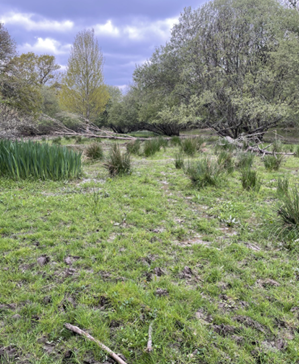
With 320 metres of Low Weald clay sitting on top of a bedrock of lime, the soil was destined to be unproductive as agricultural land and has now been transformed into a complex ecosystem consisting of grass meadows, wood pasture, emerging scrubland and water meadows, part of which contribute to a restored section of the River Adur. The land is now managed using a hands-off approach, instead allowing grazing herbivores including longhorn cattle, Tamworth pigs, Exmoor ponies and Red and Fallow deer to act as ecosystem engineers and create natural disturbance as would have been the case prior to human-driven land management practices and which promotes seed dispersal and the emergence of new and valuable complex habitat types.
Through the transformation that has taken place and the efforts of continuous monitoring and surveying, Knepp is now a hotspot for rare and endangered flora and fauna including nightingales, turtle doves, lesser spotted woodpeckers and notably the largest UK population of purple emperor butterflies. The presence and numbers of such struggling species at Knepp is testament to what landscape-scale habitat recovery can achieve in a relatively short timeframe.
Although the main ethos of Knepp is to allow nature to take its own course, there has been a small number of exceptions in which target species have been introduced to the site using careful management techniques. One example of this is the introduction of beaver to Knepp as a trial site for further possible reintroduction throughout England and another notable instance is the reintroduction of white stork to the site in 2016, a species which has experienced reintroduction success across parts of Europe including Poland, Sweden and Switzerland, just to name a few.
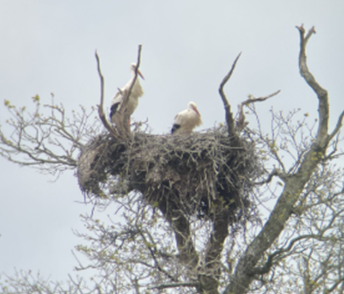
Beginning with the introduction of a number of captive reared and rehabilitated birds to the site in order to establish a founding population, only four years later did successful breeding take place at Knepp and has continued each subsequent year. On the day of my visit, a number of eggs had already been laid and three chicks had hatched, providing hope for another year of success for the white stork and encouragement for the resilience of white stork populations.
Through ringing and tracking efforts of the white stork, results have shown that birds hatched at Knepp have completed successful migrations into Europe and as far as Morocco, presumably integrating with wild colonies and contributing to global white stork populations.
As someone whose PhD research focuses on the behavioural adaptation of white storks and stakeholder perceptions of their reintroduction in the UK, visiting Knepp felt particularly meaningful. Seeing a reintroduced population thriving in a British landscape — foraging, nesting, migrating — provides a valuable real-world context for the questions I am exploring around what makes reintroduction successful and how land managers and communities feel about sharing their landscape with a large and conspicuous wading bird.
If this is a topic that resonates with you, I am currently running a short anonymous survey on public and stakeholder attitudes towards white stork reintroduction — it takes 10–15 minutes and all perspectives are welcome and can be accessed here.
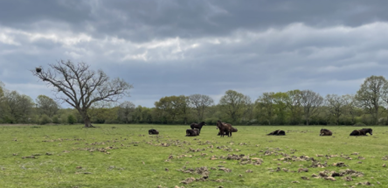
The personal highlight of the day was witnessing first-hand just how quickly and dramatically nature can recover when given the space to do so — particularly in areas that might previously have been dismissed as unproductive or ecologically marginal. Knepp is, of course, an exceptional case, and the scale and circumstances that enabled it are not replicable everywhere. But it raises a genuinely important question: what nature-based solutions might be achievable in other contexts, whether on a smaller scale, or through the connection of multiple similar habitats across the country?
After visiting Knepp, I was left with a sense of optimism that although the natural world is currently facing very real pressures that at times may feel irreversible, when given the space to be, nature is resilient and recoverable and can provide unexpected benefits.
Related Posts
Showcasing Harper Adams at the UKACT Annual Conference 2026
By Dr Ellen Williams "Harper Adams are very well represented this year, aren’t they?"What a fabulous thing to hear at the UKACT A …
Posted 28 August
 Confused meerkat or sleek workshop host? A look into the BIAZA research conference 2026
By Dr Ellen Williams As a Professional Member of the British and Irish Association of Zoos and Aquariums (BIAZA) and a Member of their …
Posted 24 July
Confused meerkat or sleek workshop host? A look into the BIAZA research conference 2026
By Dr Ellen Williams As a Professional Member of the British and Irish Association of Zoos and Aquariums (BIAZA) and a Member of their …
Posted 24 July
 Harper Adams colleagues forge research links with Halesowen College
Four members of the Animal Behaviour and Welfare Research Group (Dr Holly Vickery, Dr Ellen Williams, Jen Sadler and Alice King) had an exci …
Posted 22 June
Harper Adams colleagues forge research links with Halesowen College
Four members of the Animal Behaviour and Welfare Research Group (Dr Holly Vickery, Dr Ellen Williams, Jen Sadler and Alice King) had an exci …
Posted 22 June
 A 'good life' for pigs - and other exciting animal science research at BISAS 2026
Dr Holly Vickery attended the British and Irish Society of Animal Science (BISAS) Annual Conference in April. She has written about her …
Posted 3 June
A 'good life' for pigs - and other exciting animal science research at BISAS 2026
Dr Holly Vickery attended the British and Irish Society of Animal Science (BISAS) Annual Conference in April. She has written about her …
Posted 3 June