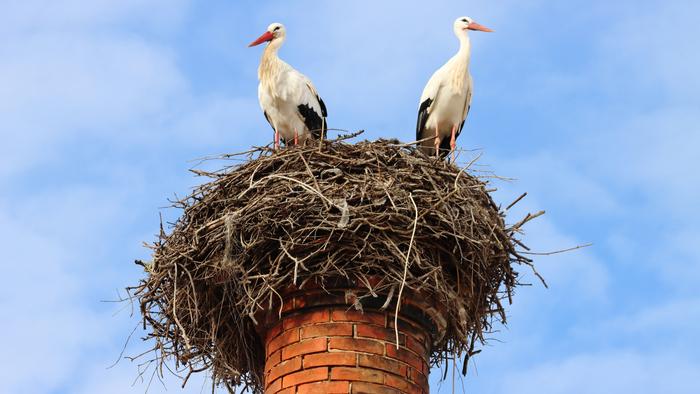
Watch/ Listen: What can White Storks tell us about the health of UK habitats?
29 May 2026
A researcher looking into the potential reintroduction of the White Stork to Britain has talked to the BBC to explain how the bird is a vital indicator of healthy habitats.
PhD student Sophie Rabone is examining the feasibility of reintroducing the bird to the country after 600 years and was interviewed for BBC Radio Shropshire about her work - and how the behaviour of both storks and humans will be vital in making any reintroduction a success
She said: “The UK has faced huge declines in wildlife. It's one of the more nature-depleted countries in Europe.
“It's a flagship species in that it's quite identifiable - and also for cultural and social reasons as well: it comes to people's minds because it's got quite traditional links to old wives’ tales and stuff.
“People are aware of the species, it's a flagship species, and it's also a species that can be used to indicate the quality of a habitat, because they rely on their habitat quality quite specifically.
“So if they are in an area and leave an area, that indicates there's something going wrong with that habitat or that ecosystem.”
Applying research
Applied Zoology graduate Sophie has visited some sites in the UK where the storks have already been reintroduced, and which are now starting to attract wild birds – but stressed a wider-scale reintroduction would need to prove a success for both storks and the people who would be living alongside them.
She added: “My research has got two aspects to it.
“One side is looking at the behaviour of the White Stork. We aren't directly reintroducing White Stork ourselves, we're studying White Storks to see how suitable they are for reintroduction on the behavioural side.
“So if they could be reintroduced, essentially, how will they behave - will they be able to support themselves and develop a population that doesn't rely on humans supporting them the whole way?
“They need to become self-sustaining - and it if it is a population that is going to be successful, they have to be self-sustaining. It can't just be a human-fed population for the whole time, because then it isn't it isn't a wild population.”
The other side of Sophie’s work involves talking to farmers, landowners, land managers and the general public and building a picture of what they think – attitudes which she is also capturing through an online survey.
She added: “It's gathering the perspective of all these different groups on what they think of White Stork - how much they know about White Stork and if White Stork were more present, the effects that they would have on day-to-day life.
“Then it’s also gathering these concerns and any mitigations
“In order to potentially reintroduce the species, you need to have all of these perspectives, because it has to be a human- wildlife relationship.
“You have to be able to mitigate the concerns as much as possible – that’s vital.”
Lecturers explain more about Sophie's stork research
Earlier this month, Sophie's research supervisor - Principal Lecturer Dr John Reade - and Senior Lectuer in Animal Behaviour and Welfare, Dr Ellen Williams were also invited onto Wild Earth News on YouTube to talk some more about her research and its importance.
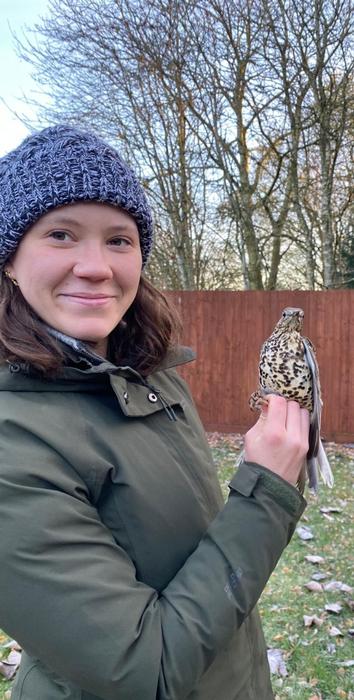

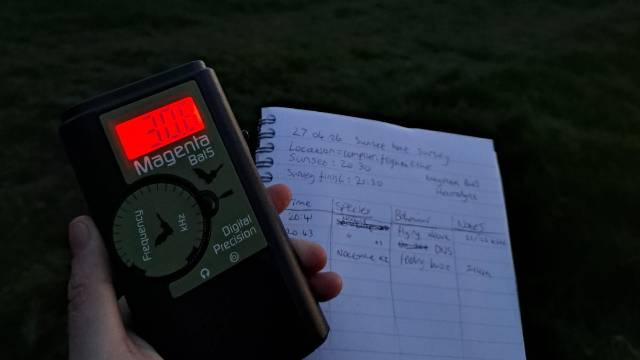 Stepping into the dark: Kai takes us Bat Surveying
In this guest blog, first year BSc (Hons) Wildlife Conservation and Ecology student, Kai Sweet, tells us about his …
Posted 24 July
Stepping into the dark: Kai takes us Bat Surveying
In this guest blog, first year BSc (Hons) Wildlife Conservation and Ecology student, Kai Sweet, tells us about his …
Posted 24 July