
RESEARCH: On-farm storage and bioreduction method
Posted 12 November 2010
Watch the video on our YouTube channel.
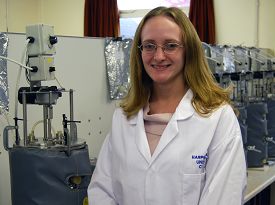
Researchers at Harper Adams University College are hoping to develop a new method of on-farm storage and bioreduction that can be used in the disposal of fallen pig carcases.
Changes to EU Animal By-Products regulation 1774 in 2002 have meant that producers can no longer openly burn and/or bury their fallen livestock. Farmers now have to use alternative methods of disposal, increasing costs.
By using anaerobic digestion (AD), researchers at the University College in Shropshire hope to develop a less expensive method that allows farmers to bioreduce their fallen livestock on-farm and dispose of it at a later date.
Marie Kirby, Postgraduate Research student, said: “AD is quite a simple process involving the transformation of organic material into biogas, by a mixed bacterial culture without the presence of oxygen.
“This biogas contains methane and if this is of a sufficient quantity- above 60%, it can be used to produce heat or electricity.
“Here, with the help of some digestate, we are using 12 10 litre custom built AD vessels to digest various diets including sugar beet pulp and meat. We’re also feeding these vessels at different levels and at two temperatures to determine the ultimate operating conditions required for the effective fermentation of meat.
A series of experiments are now being conducted to determine the suitability of AD, by monitoring the degradation of carcass material, quantity and quality of biogas, fermentation products and the level of pathogen destruction.
Samples are taken from a variety of ports on the vessels, an internal blade system stirs each vessel and a collection pipe allows the biogas to be monitored.
Marie added: “This research began more than two years ago and prior to this we surveyed livestock farmers to find out what their current methods of disposal are and how they would like to progress. AD was one of methods that they would like to use on-farm.
“If we gain enough supporting evidence then we can address the EU and convince them to consider AD as method for on-farm storage for livestock carcases, because at the moment it is illegal to use it for fallen livestock, although Harper Adams has a special licence for this.
“At the moment the project is sponsored by BPEX and Harper Adams and hopefully it can continue with an on-farm pilot to see if it really is an effective method for pig farmers.”
Most popular
-
 Her Royal Highness The Princess Royal to formally launch Harper Adams University's 125th anniversary celebrations
2 September -
 Harper Adams University launches free and immediate mental health and wellness support for students
18 September -
 Expanded clearing places designed to meet industry challenges
17 August 2022 -
 Watch: Students join 125 years of pioneers at 2026 Graduation ceremonies
16 September -
 Harper Adams University and Lincoln University, New Zealand, launch global agricultural futures alliance
17 September -
 First Honorary Degrees and Fellowships to be bestowed as Harper Adams University marks 125th year
10 September