Student research to improve lamb survival rate
Posted 14 April 2015
Watch the video on our YouTube channel.
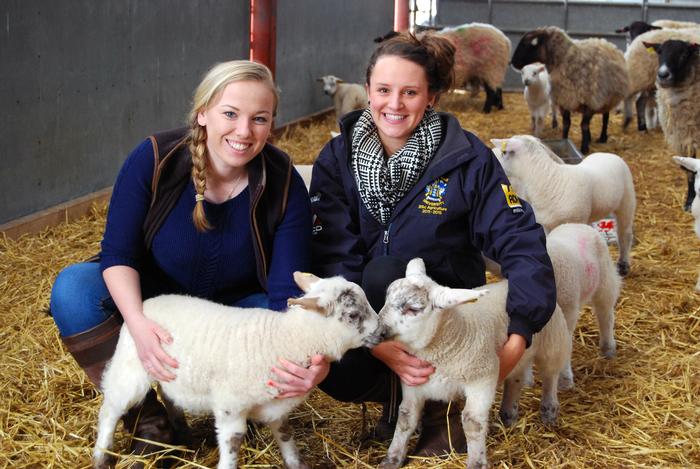
Final year Harper Adams agriculture students are investigating the effect of body condition score and level of protein supply on ewe and lamb performance, as part of an EBLEX-sponsored trial.
The six students are each analysing different aspects of the project, including the yield and composition of colostrum and milk; and the effects on colostrum IgG concentration and absorption by lambs.
During the 10-week trial, 48 twin-bearing ewes were housed in different treatment groups – high body condition score (BCS) and low protein, high BCS and high protein, low BCS and low protein, and low BSC and high protein.
Throughout the trial, ewes were housed individually from six weeks pre-lambing to four weeks post-lambing, and fed ad-lib straw and an iso-energetic concentrate formulated to supply different levels of digestible undegradable protein (DUP) supply.
22-year-old Verity Hyland from Yorkshire has been researching how the different treatments affect the yield and composition of both colostrum and milk.
She said: “We milked the ewes at 12 and 16 hours after lambing and also at 21 days to measure the colostrum and milk yields. We also took samples for compositional analysis. During the trial, blood and faecal samples were also taken and lamb weights were monitored and recorded weekly.
“The protein requirements of ewes increases dramatically during late pregnancy and early lactation and I’m hoping that the results will show that ewes will respond to additional protein supply above currently accepted requirements, and that this response may vary depending on the ewes initial BCS.
“Potentially this could help sheep farmers to have an improved understanding of how much protein is required during this key nutritional period. This could then lead to improved lamb survival rate as well as improved efficiencies and cost savings.”
Previous research has shown higher levels of protein and energy are required during the later stages of pregnancy to allow for lamb growth, udder development and colostrum production.
Immunoglobulin G (IgG) is the major immunoglobulin in the body and it is important that it is passed from the ewe to a new born lamb via colostrum – the first milk from the ewe.
Gina Lamb, 22 from Northumberland has been investigating the effect of the different treatments on the IgG concentrate of colostrum and the efficiency of absorption by lambs.
She said: “Research has shown that IgG absorption by lambs is dependent on both the quantity of colostrum consumed by lambs and the amount of IgG within the colostrum.
“At 16 hours and 21 days after lambing, colostrum and milk quality were tested, as well as blood samples taken to assess the IgG concentration.
“Higher levels of IgG in the lambs will improve their immunity, decreasing their chances of disease and give them a real fighting start.
“This research could help farmers to know how much protein to feed to optimise lamb output and colostrum quality, leading to potential savings within lamb survival, higher weaning percentage and protein use.”
This trial is part of an on-going research project conducted at Harper Adams University on behalf of EBLEX – the beef and lamb division of the Agriculture and Horticulture Development Board (AHDB).
Most popular
-
 First Honorary Degrees and Fellowships to be bestowed as Harper Adams University marks 125th year
10 September -
 Harper Adams University and Lincoln University, New Zealand, launch global agricultural futures alliance
17 September -
 Expanded clearing places designed to meet industry challenges
17 August 2022 -
 Students join 125 years of pioneers at 2026 Graduation ceremonies
16 September - Groundbreaking new study aims to examine neurodivergence in agriculture
7 September -
 Her Royal Highness The Princess Royal to formally launch Harper Adams University's 125th anniversary celebrations
2 September
Related articles

Harper Adams University secures £5 million Leverhulme grant to launch Transformative Farming doctoral programme
Posted 1 September
University to host national Stakeholder Showcase for groundbreaking nutrient recovery and slurry innovation project
Posted 20 August