

Future Farm sheep research helps cut UK carbon ‘flockprint’
Posted 1 June
We are proud to have contributed high-quality data from our performance-recorded Lleyn flock to support the development of these breeding tools. They will help sheep farmers lower their farm’s carbon ‘flockprint’ without compromising flock productivity, efficiency or health."
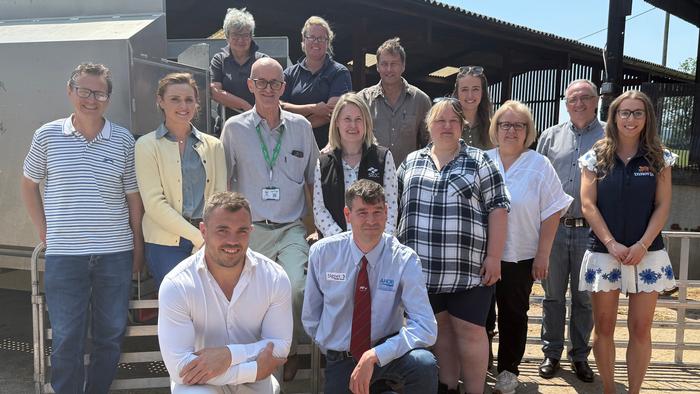
Partners in the Breed for Ch4nge project at a recent event launching the index, with Dr Sarah Morgan centre in check shirt
Data from hundreds of Lleyn sheep on the Harper Adams University Future Farm has helped shape a new index aiming to cut the climate impact of the UK’s sheep flocks.
The performance-recorded flock on the farm was among those selected to take part in a £3 million industry-led research project developing a new methane output breeding value (EBV) and environmental selection index for UK sheep.
The ground-breaking three-year ‘Breed for CH4nge’ project, funded from DEFRA's Farming Innovation Programme, measured how much methane was produced from more than 13,500 lambs across the UK.
In Shropshire, nearly 600 lambs from the Future Farm were assessed for the research, which culminated in the development of a new breeding value (EBV) for methane output. This value, alongside several flock performance traits, feeds into a new Breed for CH4nge environmental index ranking animals on their breeding potential for a naturally low carbon footprint.
Flocks will be able to draw upon these new breeding tools to lift productivity – and also help reduce climate impact at the same time.
Sustainable
Dr Sarah Morgan, Beef and Sheep Production lecturer and principal investigator for the project, said: “We are proud to have contributed high-quality data from our performance-recorded Lleyn flock to support the development of these breeding tools.
"They will help sheep farmers lower their farm’s carbon ‘flockprint’ without compromising flock productivity, efficiency or health.
“Several barriers currently exist with using short-term mitigation options, such as methane-mitigation feed additives, with animals that spend most of their lives grazing - therefore genetic selection offers an available, permanent, cumulative and sustainable answer to carbon footprint reduction for grazing-based systems.”
Academics at Harper Adams worked closely with 11 partners across industry and academia on the project, delivered by Innovate UK and led by Innovis.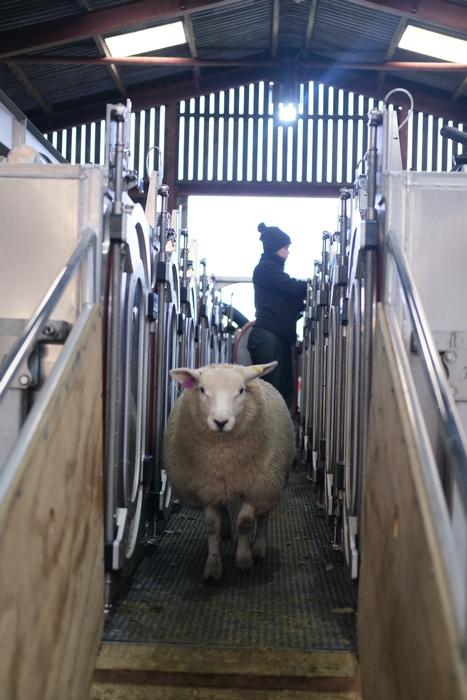
Profitability and performance
Elizabeth Creak Chair in Agri-Tech Economic Modelling Professor Karl Behrendt and senior lecturer Dr Eric Siqueiros worked with data and expertise within the project to combine genetic modelling, whole-farm system bioeconomic modelling, and carbon footprinting to determine if better breeding decisions and genetic selection can make a real difference to both the profitability and environmental performance of UK sheep farms.
Professor Behrendt added: “Our unique approach has demonstrated that selecting rams for improved maternal traits, growth, and efficiency using current maternal indexes can reduce emissions per kilo of lamb produced.
“These gains are not instant, don’t come from a single trait and will vary with different maternal selection indexes, but once the new genetics flow through the flock and improve how the whole system functions, the benefits build over time, with better sheep production system efficiency, lower emissions intensity and improved farm returns.”
In addition to the methane, flock productivity and parasite resistance data collected on the Future Farm flock, a sub-set of the lambs were also evaluated for how efficiently they use their feed relative to their size, weight and growth rate.
Nicky Naylor, Senior Lecturer in Animal Production and Health, said: “Our involvement in the ‘Breed for CH4nge’ project has built on the previous work that we have undertaken on parasite resistance in the Harper Adams Lleyn flock and has also supported a number of final year dissertation projects, meaning this work has not only benefitted our flock, but also our students – as well as the wider sheep industry.”
These new breeding tools will be available this season for maternal rams from Innovis and will soon be available across the other progressive, performance-recording maternal sheep breeder groups involved in the project - Sheep Improvement Group (SIG), Performance Recorded Lleyn Breeders (PRLB) and Centurion Group of Dorset Sheep Breeders.
Most popular
- Fresh opportunities to study in Australia and New Zealand unveiled
19 October -
 Honorary Degree celebrates Archers star's 40 years illuminating rural life
14 October -
 Graduate wins both British Farming Awards and Farmers Weekly Ag Student of the Year prizes
16 October -
 Scale of rural crime underestimated, expert tells MPs
15 October -
 Smart data disease prediction project earns engineer prestigious award
12 October -
 Graduate planning to transform Shetland farming named Farmers Weekly Ag Student of the Year
2 October