
Entomophagy at Harper Adams
Posted 1 May 2020
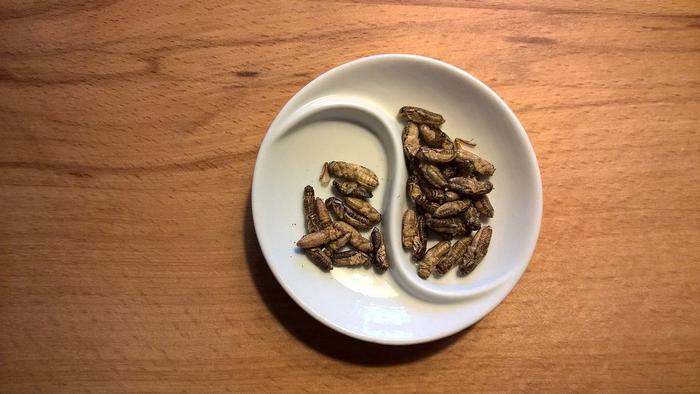
Eating insects is not a new concept. Humans have probably always eaten them and it’s even referred to in the Old Testament and in Ancient Greek and Roman texts. Approximately a third of people around the world include insects in their diet, especially in Asian, Latin American and African countries. For example, in Colombia ‘hormigas culonas’ (big-bottomed ants) are seasonal delicacies that cost more than the country’s famous coffee.
In 2012, Harper Adams become the new centre of excellence for entomology teaching and research in the UK and welcomed its first entomology postgraduate students in the September of that year. A year later and the concept of entomophagy (eating insects) started creeping into the university’s Marketing and Communications Department. A video was made which introduced the key messages of why we should be eating insects.
At the centre of the story of why we should embrace eating insects is the global population growth, which is predicted to reach 9.7 billion people by 2050. These people will all have to eat and this is therefore going to lead to even more pressure on food; further increased by other factors such as more crops are nowadays being grown for biofuels, less resources and climate change. Eating insects is therefore a potential part of the solution as they provide a high-protein food with less water, space and lower emissions.
The biggest barrier to insects being a common food source in the UK is the public’s perception. The Harper Adams Shows and Events team therefore decided to take the concept out on the road; seeing how many people would eat insects at agricultural shows across the UK and Ireland while also sharing the benefits of eating them.
The ‘Edible Bug Challenge’ was a huge success; in its first year over 5,000 people took it on, including BBC’s DJ Scott Mills.
It wasn’t just at agricultural shows that Harper Adams was sharing the story of entomophagy; it was taken into schools too. The Harper Adams Schools Team created a bespoke session which was, and still is, presented at a number of local schools. During the session, the pupils discuss the effects of a growing population and how they will all be fed. They are introduced to the concept of entomophagy and invited to try some insects for themselves.
In 2016, Harper Adams hosted the first entomology conference for teenagers. One of the sessions was delivered by Gastronaut Stefan Gates and was about entomophagy. During the session, he highlighted that even though people are disgusted by the idea of eating insects, they already feature in some of our food choices. For example, if you look at a digestive biscuit under a microscope you can see insects in it and some food that use red food dye, such as pink marshmallows, get their colouring from cochineal’s blood.
At the time of the event, Stefan said: “You can go on an adventure in the comfort of your own kitchen or own garden. The idea that you can wonder out into your garden, pick-up some woodlice, briefly boil them and then and make a sort-of prawn cocktail but using woodlice, that is an adventure!
“Can eating insects save the world? Eating insects is one of the solutions. It’ll be 20 years until eating insects is here in Britain on a big scale but let’s not forget that two billion people around the world eat insects on a regular basis.
“It’s not weird. If we want to save the planet’s resources, use less land, use less water, if we want to make better use of the resources we’ve got, I don’t think we’ve got another option; we need to start eating insects on a massive scale. We already do it, remember those pink sweets that you eat, they are made with cochineal bug blood.”
However, it’s believed that in Britain, the best way to get insects into people’s diets is through creating products that hide the insect ingredients.
In 2018, business student Tom Evans completed his dissertation into British public perception of eating insects, including consuming products from livestock fed insects, after identifying edible insects as a potential business opportunity.
He said: “My sample indicated there was mixed acceptance for insect protein in foods. This is when insects are milled and mixed into a sort of flour that can be used as an ingredient in other products, such as flapjacks.
“The majority of participants were willing to include them in their diet if they were deemed better for the environment; more sustainable, less greenhouse emission, smaller carbon footprint, as long as they couldn’t see the insect parts in a product. But the sample studies also indicated they would never replace insects for meat.
"I did this project because of the growing global population which means something needs to change so that we can all eat. Insects can feed on anything, there is huge scope for feeding our food waste to insects which in turn will become an important source of animal feed.”
Public perception to eating insects appears to have started changing since that first entomophagy video from Harper Adams was released. It’s changed so much in fact that in November 2018 Sainsbury’s became the first UK supermarket to stock an edible insect product.
At the time Rachel Eyre, Head of Future Brands at Sainsbury's, said: “Insect snacks should no longer be seen as a gimmick or something for a dare, and it’s clear that consumers are increasingly keen to explore this new sustainable protein source.”
Last year, Professor Frank Vriesekoop and Luis de Aguiar from the Harper Adams Food Technology and Innovation Department were involved in a project looking at researching consumer enthusiasm for non-meat based protein sources, in different parts of the world. This major study focused on plant based, cultured meat and insect-based protein alternatives.
Research continues at the university in to ways of bringing insects to British consumers' plates.
Most popular
-
 Fresh opportunities to study in Australia and New Zealand unveiled
19 October -
 Graduate wins both British Farming Awards and Farmers Weekly Ag Student of the Year prizes
16 October -
 Honorary Degree celebrates Archers star's 40 years illuminating rural life
14 October -
 Scale of rural crime underestimated, expert tells MPs
15 October -
 Smart data disease prediction project earns engineer prestigious award
12 October -
 Graduate planning to transform Shetland farming named Farmers Weekly Ag Student of the Year
2 October