Pan-European climate change research project launched
Posted Today
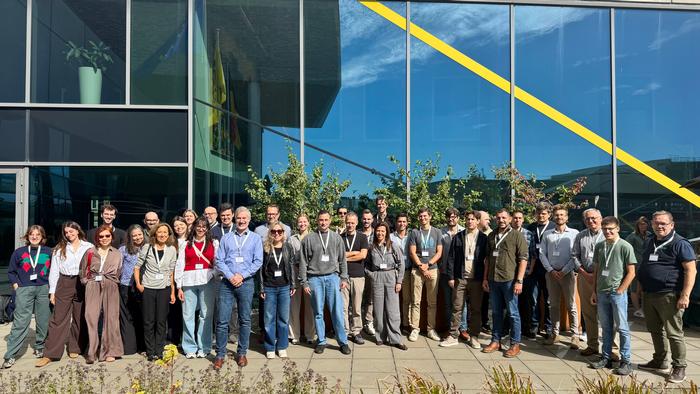
The ClimAurea consortium at the kick-off meeting in Ghent - picture credit: Aleksandra Anđelković, Future Systems Hub, Novi Sad, Serbia
A new pan-European research project will examine how climate change could affect the continent’s agriculture – with Harper Adams University academics playing a key role.
The ClimAurea project brings together 13 partners from nine countries, who will examine how Europe’s changing climate will affect farming - and develop and test practical tools with farmers to help them adapt.
Harper Adams Team Lead for the project, Professor Karl Behrendt, said: “The summer of 2026 was the hottest recorded in the UK since records began in 1884, while England and Wales experienced their driest July on record.
“These extreme conditions have placed considerable pressure on agricultural production and demonstrate precisely why research into climate adaptation and agricultural resilience is needed.”
Professor Behrendt and the rest of the Harper Adams team will look at the measures farmers are already taking to adapt to climate change, talk to farmers and other stakeholders, and develop economic assessment tools to evaluate the costs, benefits and feasibility of each measure under different climate scenarios.
By participating in ClimAurea, the team at Harper Adams University aim to strengthen the evidence base for practical, economically viable adaptation strategies, helping farmers and policymakers respond to increasing climate risks while maintaining agricultural productivity and competitiveness.
After a launch event at the start of the autumn in Belgium, the project is now fully underway. It is coordinated by EV ILVO (Flanders Research Institute for Agriculture, Fisheries and Food) in Belgium, with scientific coordination by the University of the Aegean in Greece. Research institutes, universities, farmer organisations and technology companies from across Europe will all be working on the project over its three-year lifespan.
Through looking ahead to 2030, 2050 and 2100, ClimAurea will explore how changing temperatures, rainfall patterns and extreme events could affect crops, grasslands and livestock across Europe – examining not only at what the future climate might be like, but at what these changes could mean in practice: whether certain crops may become less suitable for particular regions, how drought or flooding could affect production, and which changes in farming practices could help.
The project will ultimately bring this knowledge together in an interactive digital tool, a “digital twin” of European agriculture, allowing users to explore future climate scenarios and possible adaptation options.
A multilingual, AI-powered advisory system will help make complex scientific information more accessible to farmers, agricultural advisors and other users.
Because climate challenges differ between areas, ClimAurea will also work directly with farmers and agricultural stakeholders in four regions facing very different pressures:
- Those in Thessaly, Greece who face flooding, drought and heatwaves
- Those in West Flanders polders, Belgium who face heatwaves, floods and drought
- ?hoseThose in Tara Calatei, Romania – who face drought and flooding in high-nature-value farmland
- And those in Alentejo, Portugal – who face chronic drought and heat.
Two further regions will be added later in the project to cover other parts of Europe. Together, farmers and researchers will explore adaptation strategies ranging from crop and water management to changes in livestock and pasture management, so that the solutions developed respond to real farming conditions and provide useful lessons for other European regions.
Theodoros Chalazas, ClimAurea Project Coordinator at EV ILVO, added: “Climate change will affect agriculture differently from one place to another. By bringing together open geospatial data, Earth observation and climate and agricultural modelling, we can better understand what these changes could mean.
“Through ClimAurea, we want to make that knowledge useful to farmers, advisors and policymakers as they explore adaptation options and plan for the decades ahead.”
Most read
- Academic scoops prestigious environmental award
Yesterday -
 Applications open for prestigious MIBTP PhD scholarships at Harper Adams University
9 November -
 Conference explores how technology can transform livestock farming
10 November -
 Vital soil research presented at global symposium
13 November -
 Harper Adams University lights up for 125th anniversary Festive Celebration
28 October -
 PhD student's pride at helping continue University's poultry research tradition
3 November