

Warming worms - potato pest research
Posted 7 September 2011
This experiment into climate change is part of our on-going research programme that we’ve been doing at Harper Adams for 20 years.
Watch the video on our YouTube channel.
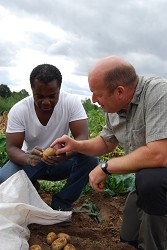
Researchers at Harper Adams University College are investigating whether temperature and climate change affect the growth of a common potato pest found in two thirds of the UK’s crop fields.
Potato Cyst Nematodes (PCN) are microscopic worms that attack the root systems of potato plants and prevent them from sufficiently absorbing water and nutrients, leading to a reduction in yield.
Researchers at the University College in Shropshire are working with Dr Vivian Blok and PhD student Agata Kaczmarek at the James Hutton Institute in Scotland to monitor crop development throughout the season to see how PCN develops in relation to temperature.
Dr Pat Haydock, Reader in Nematology at Harper Adams, said: “We have a typical infestation of PCN at a site about four miles away from the University College at a local potato grower’s field.
“We are monitoring the crop development on a monthly basis and looking at the nematodes in the roots and soil. This site in Shropshire will then be compared with a much colder site in Luffness, Scotland, to see if there is any correlation between temperature and nematode growth and development.
“We’re also looking at the potential for a second generation of nematodes, which is something that we are concerned about as soil temperatures gradually increase in the UK. The Climate Research Unit at the University of East Anglia has predicted rises in mean annual temperatures of 2 to 3 C by the year 2050 in England.”
At the end of the growth period of the potatoes, the mature female nematodes drop into the soil and within each of these lies several hundred dehydrated nematodes. These can survive dormant in the soil for up to 15-20 years, and hatch when specific natural chemicals are leeched from the roots of potato plants years later.
Unlike fungal or insect pests, PCN cannot be eradicated easily using fungicides or insecticides, meaning research into integrated control methods is crucial for farmers.
Dr Haydock, added: “This experiment into climate change is part of our on-going research programme that we’ve been doing at Harper Adams for 20 years, where we’ve looked at the basic biology of the pest and how that understanding can be used to develop control methods.
“Another project that we are currently looking at is with PhD student, Patrick Norshie, which investigates the integrated control of nematodes - using chemical methods, resistant varieties and long crop rotations.
“We’re also about to embark on a new PhD which will explore the effects of bio-fumigation, using plants that produce natural substances that can control PCN.
“All of our field experimentation is the culmination of not just work done here at Harper Adams, but also at other institutions. It is important that research initially undertaken in glasshouses and small plots can be transferred to commercial field situations for the benefit of potato growers.”
Most popular
-
 Harper Adams University and Lincoln University, New Zealand, launch global agricultural futures alliance
17 September -
 Harper Adams University launches free and immediate mental health and wellness support for students
18 September -
 Watch: Students join 125 years of pioneers at 2026 Graduation ceremonies
16 September -
 Expanded clearing places designed to meet industry challenges
17 August 2022 -
 Her Royal Highness The Princess Royal to formally launch Harper Adams University's 125th anniversary celebrations
2 September -
 First Honorary Degrees and Fellowships to be bestowed as Harper Adams University marks 125th year
10 September


