

International coffee research project set to boost plants and producers
Posted 3 March
“The key to keeping coffee production may be contained within the genomes of these 120 or so wild species of coffee, found mostly in Africa."
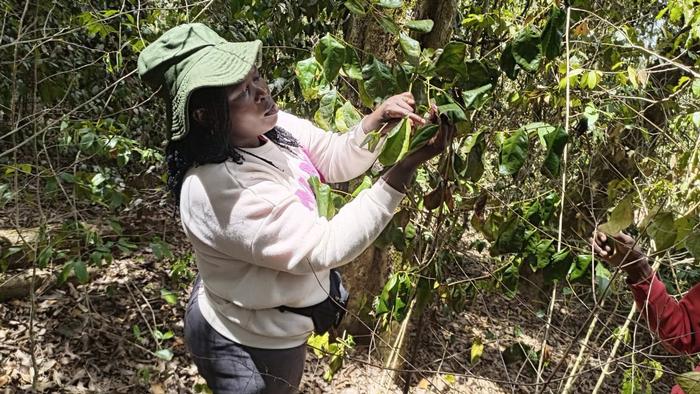
Field work was conducted for the orject in Kenya by Angeline Mwova
Coffee lovers can relax knowing new ways to support plants and producers in Africa are being found - thanks to research funded by Harper Adams University.
The global coffee industry is worth around 100 billion dollars each year, and of crucial importance to small farmers as well as the millions who start their day with a cup - but the diversity of coffee crops around the world is facing a series of challenges as our climate warms.
To meet these challenges, an international research team set out to discover ways in which the plants could be protected through natural means.
They examined of two sets of coffee plants in Kenya’s Taita Hills – the wild Coffea fadenii and the commercially-grown Coffea arabica – to assess the best ways to protect and support coffee plants – and the farmers who grow them.
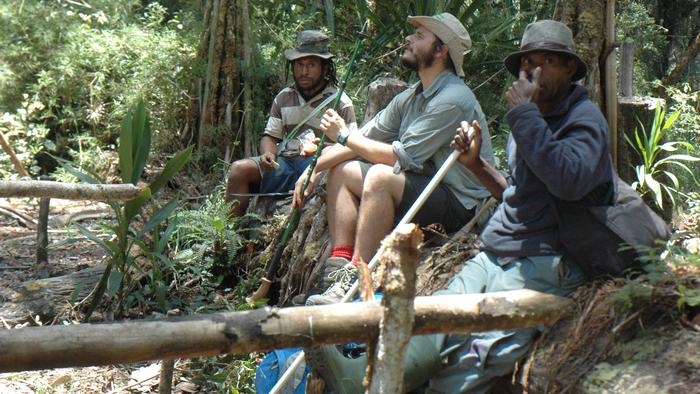
Dr Simon Segar, a Senior Lecturer in Entomology from Harper Adams University – which funded the work through quality-related research (QR) funding – said: “We all enjoy a good cup of coffee, but as the World’s climate changes, so do the threats to our favourite beverages.
“For example, pests of coffee berries will likely intensify as things heat up - while at the same time, it will become harder to cultivate coffee even at higher elevations.
“To tackle this challenge, we decided to focus on an endangered forest species that grows within a short distance of a popular cultivated coffee species.
“We wanted to know if these species shared pollinators, insect herbivores, and natural enemies.
“Can the same insects support both species, for example?
“This can help us to understand where and how to grow cultivated coffee and how to better protect wild species.”
The study is important, Dr Segar believes, because the wild relatives of commercial crops hold valuable information which could keep coffee production thriving.
He added: “The key to keeping coffee production may be contained within the genomes of these 120 or so wild species of coffee, found mostly in Africa.
“Around 60 per cent of these wild relatives are themselves at risk due to land use change. The number one coffee species grown today, Coffea arabica, is itself a natural hybrid, one parent being the wild Coffea eugenoides.
“These wild species have desirable features, including resistance to pests, resilience to climate change and in some cases, naturally low levels of caffeine.”
As the study developed, Dr Segar helped design experiments and select sites in Kenya from his base at Harper Adams University – while in Africa, field work was conducted by Angeline Mwova and supported by Dr Mark Otieno from the University of Embu, Professor Esther Kioko from National Museums of Kenya, and Dr Everlyne Samita from Kenyatta University.
Dr Segar added: “The team was great, and we all contributed in different ways, be that pollinator biology, species identification or support with experimental design and analysis.
“Functional diversity in pollinators is important. Pollinators collect and deliver pollen to and from plants in different ways and at different times of the day, so for maximum coverage - along with taste and yield - you want to maximise the types of pollinators that are involved.
“While we studied flower visitors, which may or may not pollinate, we did see that beetles and flies visited flowers alongside bees. This means that pollination services can be more resilient to change, because the community of potential pollinators contains insects that will respond differently to the prevailing conditions, ensuring delivery of pollen services across a range of conditions.”
The research was the first to study the pollination of wild coffee in this way – and Dr Segar said they were somewhat surprised to find there was little interlap between those pollinators which visited wild plants and those which visited cultivated crops.
He added: “On the one hand, these species share many of the same flower traits and from what we know pollinators are not fussy in terms of visiting either of the two cultivated species. They are generally not specific to a given plant species.
“On the other hand, the wild species that we studied loves old growth forest and these differences in habitat mean that the pool of available insect pollinators is likely different.
“The differentiation is remarkable though - and means that these two species likely operate as independent components of the wider pollination network.”
Dr Segar believes the research findings could prove important for coffee producers – who can use them to diversify their coffee crops, using different plots and habitats at a very local scale.
He added: “They are also important in terms of arguing for habitat protection and the preservation of the region’s unique flora in larger blocks: would pollination among isolated individuals of wild coffee be sustainable?
“Many questions remain - and we still need to write up the results of Angeline’s work on insect herbivores and natural enemies!”
The full research can be found in the International Journal of Tropical Insect Science.
Most popular
-
 First Honorary Degrees and Fellowships to be bestowed as Harper Adams University marks 125th year
10 September -
 Expanded clearing places designed to meet industry challenges
17 August 2022 -
 Harper Adams University and Lincoln University, New Zealand, launch global agricultural futures alliance
Yesterday -
 Students join 125 years of pioneers at 2026 Graduation ceremonies
16 September -
 Groundbreaking new study aims to examine neurodivergence in agriculture
7 September -
 Her Royal Highness The Princess Royal to formally launch Harper Adams University's 125th anniversary celebrations
2 September
Related articles
Harper Adams University and Lincoln University, New Zealand, launch global agricultural futures alliance
Posted YesterdayStudents join 125 years of pioneers at 2026 Graduation ceremonies
Posted 16 September