

First wines from Harper Adams University's vineyard to be launched this week
Posted 28 April
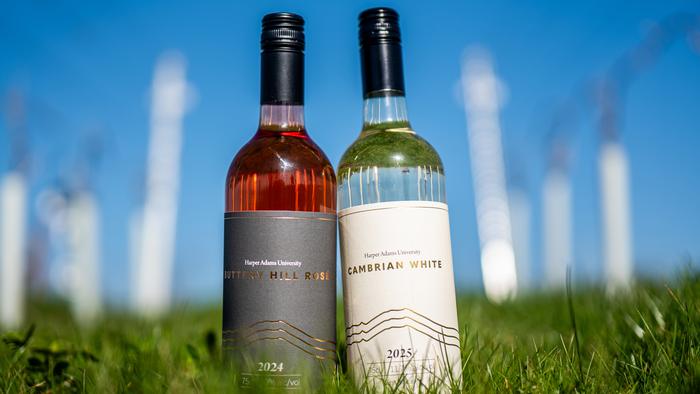
Wine growers, sellers and more from across the West Midlands are coming together to celebrate the launch of a unique wine – the first ever produced by Harper Adams University.
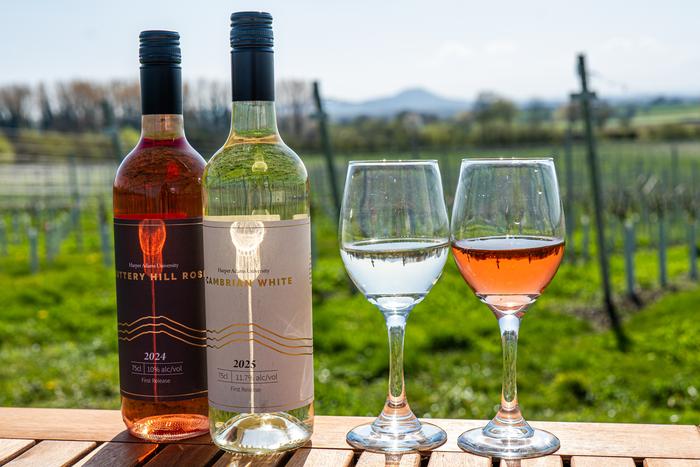
The new Buttery Hill Rosé is one of the first two commercially available wine ranges produced from grapes grown on the University’s own estate in Edgmond, Shropshire.
Frank Vriesekoop is a Professor in the University’s Harper Food Innovation department and was closely involved with the University vineyard’s development.

He said: “It is quite a fulfilling feeling - the fact that we planted a variety of vines in 2023, and by 2024 obtained a small harvest that yielded our first rosé wine from across all our varieties, is very satisfying. That 2024 rose is now bottled and available for drinking.
“Then, in 2025, we were able to achieve a proper harvest that has gone into three main batches for future wines. The first batch - a still white wine - has now been bottled and is an extremely pleasant dry-white.”
More than 1,100 vineyards are registered across England and Wales, and with a changing climate opening new possibilities for wine growing in regions such as the West Midlands, it’s hoped that Harper Adams can act as an anchor academic institution for viticulture in the region and beyond.
Professor Vriesekoop added: “The Harper Adams vineyard has been designed to do three main things – to be a classroom, be a laboratory, and be a production site.
“This allows the university to, firstly, develop and deliver hands-on courses.
“These enable people wanting to enter into the grape-growing and wine industry to be exposed to a wide range of grape varieties that are planted and pruned and maintained in a variety of ways.
“The Harper Adams vineyard is not a ‘one size fits all’ vineyard – the vine varieties range from very traditional to the more recently-developed vines that are highly disease resistant and will get to maturation in the climatic conditions of the Midlands.
“Secondly, it is set up to explore a range of vineyard management options that can be used in research projects, ranging from soil-related research to vines with different rootstocks, to rows of vines planted in different orientations, and so on.
“And finally, of course, the university will produce wines.
“These wines are examples of what future producers can exploit using different grape varieties, and the wines itself will offset the cost of maintaining the vineyard.”
A viticulture short course has already been developed by the University.
Among its aims is offering guidance farmers and landowners considering vineyard development as part of their diversification plans, with successful vineyards offering two income streams – through wine production and as tourist attractions.
Professor Vriesekoop added: “Having a teaching and research vineyard at Harper Adams provides the British wine industry – and those hoping to enter it – with an educational platform that is within reach, with no need to travel as far as previously to see and get that information.
“We purposely planted newer grape varieties that stand a much better chance to combat most common diseases encountered in grape vines, especially in a slightly cooler and damper country like the UK - when compared to most of Europe.
“This sets the scene to teach how to manage more modern grape varieties to produce grapes that will achieve maturity for the production of high-quality wines.”
The West Midlands industry already boasts a diversity of producers, with many represented at the sold-out launch of Buttery Hill Rosé, being held this Thursday at Shrewsbury Museum.
Among those speaking during the night are two from vineyards set up by former students at the University.
Rowton Vineyard was set up by alumna Zoe Evans as her family farm near Shrewsbury sought to diversify, while Halfpenny Green Vineyard, in South Staffordshire, boasts three generations of the same family who are Harper Adams alumni.
Halfpenny Green was founded by the late Martin Vickers, who went on to help set up the Harper Adams vineyard four decades later in 2023.
His son, Clive, will be on a producer panel at the wine launch, and said: “Here at Halfpenny Green, we’re proud of our association with Harper, which goes back to the late 1950’s when my late father attended, followed by myself in the 80’s and now my daughters Imogen, who has just graduated, and Emily - now in her second year.
“To have been involved in the development of the vineyard at Harper and now making the wine makes us extremely proud - however, what is more important is that the English and Welsh wine industry now has the chance to develop its skills in viticulture through courses at Harper.
“This is essential to the sector as vineyards spread ever further north.”
Watch a BBC report on the new wine launch here:
Most popular
-
 125th anniversary celebrations launched by Chancellor Her Royal Highness The Princess Royal
29 September -
 Graduate planning to transform Shetland farming named Farmers Weekly Ag Student of the Year
2 October -
 Award-winning graduate takes on Duchy of Cornwall’s first regenerative Farm Business Tenancy
6 October -
 Allied professionals can support farmer mental health - but should not be relied upon and need help themselves, study says
5 October -
 Graduation 2026: meet our alumni speakers
18 September -
 Conference and party round off 125th anniversary opening celebrations
30 September
Related articles
Dairy Manager highly commended as Young Dairy Farmer of the Year at Cream Awards 2026
Posted YesterdayAward-winning graduate takes on Duchy of Cornwall’s first regenerative Farm Business Tenancy
Posted 6 October