

Farmers' slug strike predictions boosted by new research
Posted 1 July
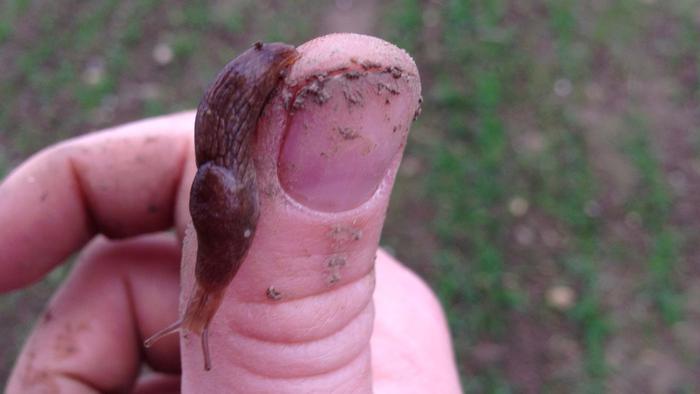
Arable farmers will soon be able to pinpoint where slugs will strike – and target them more precisely – thanks to a Defra-funded project.
Data collected by a team of 28 Slug Sleuth farmers and agronomists enabled Professor Keith Walters and his team at Harper Adams University to increase their understanding of slug behaviour, establish a model to predict where slugs will be found in arable fields, and validate it.
This modelling – which was used to produce slug prediction maps - is just one of the outputs from SLIMERS (Strategies Leading to Improved Management and Enhanced Resilience to Slugs) a three-year project led by the British On-Farm Innovation Network (BOFIN) which saw farmers and scientists working together to tackle the pests.
The successful creation of slug prediction maps unlocks the potential for more precise control of slugs in arable fields including reduced use of pesticides.
Keith said: “Coming into SLIMERS we already knew that slugs didn’t occur randomly across fields, but that they form distinct patches according to soil type and climatic conditions.
“The Slug Sleuths’ data of slug populations across their fields helped us develop that understanding further - and allowed us to confirm our hypothesis about how slug patches re-form after waterlogging.
“In waterlogged soils patches become unstable and break down, but we have now confirmed that patches reform temporarily in places we wouldn’t expect in normal conditions and then quickly return to their predicted areas once more typical soil conditions return.”
Having this additional understanding strengthened a model that was developed in the latter stages of the three-year project to explain the underpinning biology leading to patch formation. The resulting slug prediction maps were tested by the Slug Sleuths over the past autumn and winter.

Professor Walters added: “We had some glitches in the early days, but they were all solvable and this has now formed the basis of a forecasting model that I am really confident in..
“Despite low slug numbers over the testing period we have sufficient data to prove that the model works. And perhaps most importantly, that farmers are happy to use it and it fits in with modern commercial equipment.
“By working with farmers from the start, the developments we have made have been more significant and impactful. Farmers brought a different perspective and expertise. That knowledge is vital and you don’t get it unless the farmers involved have some level of ownership in the research and its outcomes.”
Bedfordshire farmer Charles Paynter said: “With the findings from SLIMERS research, together with new technical developments, we can predict slugs’ activity more accurately than before. This means we will be able to use more targeted treatments which has the potential to be less damaging to biodiversity
“My threshold for taking control measures is higher now because I have been able to prove to myself that I can evaluate the risks from slug activity with greater accuracy.”
Similarly, Nottinghamshire farm manager Richard Cross has found himself moving away from blanket applications of slug pellets since joining the project in its first year.
He said: “I’ve learned that slug issues can be controlled in a more environmentally friendly way.
“I don’t think this project is concluded yet - we need funding to get the variable rate applications out on farm to build up a data set to prove the theory.”
SLIMERS is a three-year £2.6M research programme involving more than 100 farms and seven partners concluding in August 2026.
Funded by Defra’s Farming Innovation Programme, delivered by Innovate UK, the project is led by the British On-Farm Innovation Network (BOFIN). It combines expertise from partner organisations the UK Agri-Tech Centre, Harper Adams University, the John Innes Centre, Fotenix, Farmscan Ag and Agrivation. The consortium has also been developing an Al-based autonomous system for the targeted application of biological control - and exploring 'slug resistant' wheat varieties.
Most popular
-
 Honorary Degree celebrates Archers star's 40 years illuminating rural life
14 October -
 Smart data disease prediction project earns engineer prestigious award
12 October -
 Graduate wins both British Farming Awards and Farmers Weekly Ag Student of the Year prizes
16 October -
 Scale of rural crime underestimated, expert tells MPs
15 October -
 Graduate planning to transform Shetland farming named Farmers Weekly Ag Student of the Year
2 October -
 Professor's life celebrated with opening of new entomology and ecology facility
8 October