

Humanoid robots ‘next stage’ in future of farming, Professor tells BBC
Posted 31 July
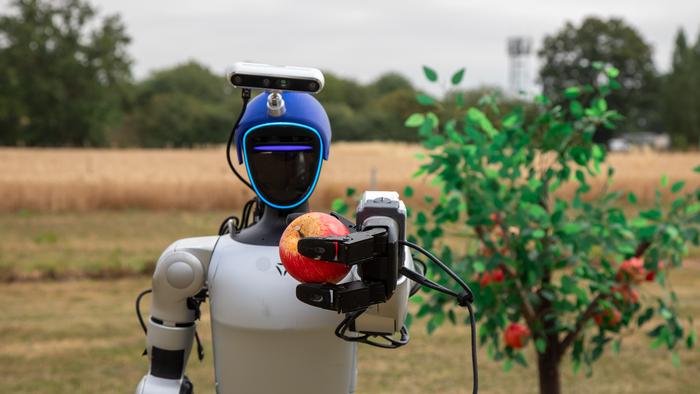
Humanoid robots could be the ‘next stage’ in the future farming, a Harper Adams University Professor has told the BBC.
With research on the technology underway at the University in Edgmond, Shropshire, Professor of Agricultural Engineering Fernando Auat Cheein spoke to the corporation for its Farmwatch series, setting out why he believes the robots - which can mimic human capabilities - could help shape farming’s future.
He said: “The reason why we're working with humanoids is because, if you look into farming problems, each one of the robots that you have now as a solution is basically an ad-hoc solution.
“You have the problem, and you have the robot to solve that specific problem - that robot cannot be used elsewhere, or to solve a different problem.
“But now we have the humanoid, the humanoid has the same degrees of freedom, the same mobility as the human body.
“We can program the robot not to solve one problem, but to solve many of them.”

One of the key reasons humanoid robots could prove so useful, Professor Auat Cheein added, is because the way we farm has been shaped by human capabilities for thousands of years.
He said: “The farming process is designed for the human body.
“Harvesting seeds, planting, whatever - everything is according to our capabilities.
“Now we have a robot that has similar capabilities, we can deploy the humanoid to do the work that we can do.
“We can adapt the humanoid to be automated, obviously, and to do the work in a faster way, and it is going to be the same robot for different problems.
“We use our own bodies to solve problems from harvesting to seeding, planting, pruning: we can now use a humanoid to do the same.”
As the Centre Lead for the Harper Institute of Technology, Professor Auat Cheein has worked across the globe honing agricultural technologies for more than 20 years – with his work on humanoid technology just the latest in a series of innovations.
He added: “Humanoids are the next stage in farming automation – because you can program the robot.
“You can teach one robot - and then replicate whatever you know to one thousand robots with no cost, or basically no cost – so this is the next stage in farming.”
Most popular
- Fresh opportunities to study in Australia and New Zealand unveiled
19 October -
 Graduate wins both British Farming Awards and Farmers Weekly Ag Student of the Year prizes
16 October -
 Honorary Degree celebrates Archers star's 40 years illuminating rural life
14 October -
 Scale of rural crime underestimated, expert tells MPs
15 October -
 Smart data disease prediction project earns engineer prestigious award
12 October -
 Graduate planning to transform Shetland farming named Farmers Weekly Ag Student of the Year
2 October